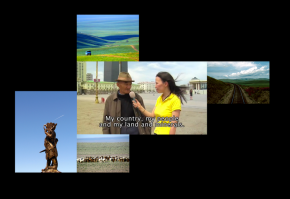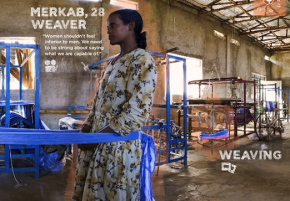
Awra Amba is a village in the Amhara region of Northern Ethiopia founded by Zumra Nuru (above) where remarkable improvements have been made in the standard of living, education, gender equality, and health through a form of utopian socialism. The Awra Amba Experience is an interactive documentary work-in-progress which will offer a platform for dialogue with and about the community and the ideas that are transforming life there.

The Awra Amba project exemplifies the iterative, evolving quality that we are seeing as producers develop work in the context of digital. The interactive proposition has grown out of a thirty minute linear documentary that launched on International Women’s Day in 2010. After a screening to a packed theatre at the Frontline Club in London turned into a long and heated debate, director Paulina Tervo realised that the film had potential as a, “a catalyst for discussion on really big universal themes -  religion, democracy, education. What is a cult? What is a Utopia? Socialism?”. Inspired by Kat Cizek’s long-term, collaborative approach to digital production (Filmmaker in residence, Highrise) Tervo decided that they should build a bigger project on Awra Amba, and she and her husband and collaborator Serdar Ferit have been gradually developing the interactive version ever since.

Screen Shot 2013-03-07 at 17.09.36 1

I’ve been interested in the project since I chaired a session with Paulina at Afrika Eye in 2011, and have talked to her a couple of times about how things are progressing. The evolution of the Awra Amba Experience is interesting from a number of points of view. Clearly the village is a fascinating subject, and Tervo has been giving a lot of thought to how to shape the interactive proposition to provide a stage for reflecting village life, and provoking a meaningful dialogue about it. In terms of ethics; Tervo is trying to rewrite what could be a colonial style media relationship into one that is reciprocal; with the village collaborating in editorial thinking, while the media makers retain sufficient editorial independence. The project is also interesting as a case study in the use of social media for audience building.

Tervo and Serdar have already produced some wonderful 360 photography in the village that you can see in the promo above. Awra Amba is a weaving community and I’m intrigued by an idea that Tervo has to produce a scarf that is designed to reflect the conversations going on within the project. She and Ferit are also hatching plans to extend the media project into an income generating fair trade business together with the Awra Amba community.

Screen Shot 2013-03-07 at 17.11.12

You can help the Awra Amba Experience come about by supporting the crowd-funding campaign on the Finnish Mesenaati platform which is live until the 13th of March. You’ll find the interview with Paulina Tervo here

The Tribeca New Media Fund has been the site of important work for some time now in interactive and participatory storytelling. As well as commissioning some standout projects, the Director of Digital Initiatives, Ingrid Kopp, has been bringing people together across disciplines to build understandings and skills in new storytelling possibilities. TFI New Media are now sharing some of that expertise and flagging wider resources through a newly launched website – the TFI Sandbox. Don’t miss interviews with producers behind interesting projects I’ve mentioned here – including Elaine McMillion – Hollow and Hank Willis Thomas – Question Bridge.

Image

Digital Bristol Week – Judith Aston, Sandra Gaudenzi & Mandy Rose at BBC Bristol

Video  —  Posted: February 14, 2013 in DCRC, Digital, Documentary, Interactive, interactive documentary, Participatory culture
Tags: , , , ,

Screen shot 2013-01-23 at 10.58.15 1

The call is out for the REACT Hub Future Documentary Ideas Labs – a unique opportunity to develop ideas in emerging documentary.

“We’re bringing together creative companies and arts and humanities academics who share a passion for telling stories to explore how the internet, user generated content and changing audience expectations are transforming what we understand by documentary media. The process of application to REACT involves participation in one of these three half-day workshops followed by a written application. Places are limited and so will be issued on a first come first served basis. To find out more about the call, about the REACT Hub, and see what kinds of projects have been produced within REACT to date, take a look at http://www.react-hub.org.uk/ Hurry. Spaces are filling up fast.

The DCRC Seeks a New Director

Posted: January 10, 2013 in DCRC, Digital

Could you be the new director of the Digital Culture Research Centre? With the Centre’s founder Jon Dovey now running the REACT Hub, and his successor Helen Kennedy heading for pastures new in Brighton, the Centre where I’m based is looking for a new director.

“The Digital Cultures Research Centre (DCRC) aims to enable, support and promote world-leading research into the reconfigurations of contemporary techno-cultures. We study the application, practices and politics of emerging technologies; we critically reflect on their ethics, values and aesthetics; we engage our research with a range of partners to further inform development strategies.

DCRC is the hub for a network of researchers from across the University of the West of England. We are actively working across Art & Design, Computer Sciences, Cultural & Media Studies and Geography to investigate the ways in which people make culture through their use of digital communications. While founded in a Cultural Studies tradition we pursue a dynamic interdisciplinary agenda. The unique character of the DCRC is our mix of criticality, creativity and application.

The DCRC Director is responsible for the vision, leadership, promotion and budget of the Centre. Applicants will have an excellent record of research in a related field, and the skills to lead a talented and ambitious team. A professorial appointment may be available for an exceptional candidate who matches the University’s professorial criteria.”

Closing date Feb 3. Find out more c/o the University of the West of England.

Screen shot 2012-12-30 at 19.20.11

1. “Bear 71 – haunting, terrific interactive doc”

The new year saw the launch of one of the best interactive documentaries I’ve experienced  - a bear’s memoir of life and death in Canada’s Banff National Park! If you haven’t seen Bear 71 give it twenty minutes of your time today. You’ll be rewarded with Leanne Allison and Jeremy Mendes’ engrossing, sad, smart meditation on the tension that results “where the wild world ends and the wired world begins.”  It’s a perfect marriage of platform, theme, and realisation. (Review January.)

2. “ i-Docs – a stellar lineup, a five minutes cycle ride from home.”

The second i-Docs Symposium took place in March. Brett Gaylor, Martha Ladly, Brian Winston, Sharon Daniel, Max Whitby were just some of the names in a terrific programme convened by Judith Aston and Sandra Gaudenzi in my new home town of Bristol. I have to declare an interest, as the event is hosted by the Digital Cultures Research Centre where I’m a fellow, and I’m a contributing editor to the i-Docs website. But the Symposium was a major event in this field, and 2012 has seen i-Docs grow into a substantial international community and thriving website which I’m proud to be part of. For a balanced view, read Brian Winston’s review of the symposium here - it’s the account of a sceptic about interactivity. Follow i-Docs on Twitter or subscribe to the site for all the latest news and upcoming events.

3. “Watching this Mad (Wo)Men remix, again.”

This terrific piece builds a collective voice of defiance from private incidents of gender conflict in Mad Men. Enjoy!

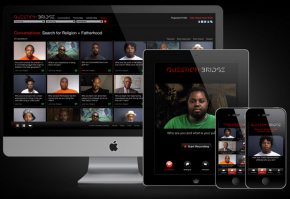
4. “The power of dialogue – Question Bridge”

At Sheffield Doc Fest in June I saw the Question Bridge installation. Question Bridge is a transmedia work about black American life and identity comprised of questions suggested and answered by participating black men. The installation works by positioning the visitor among the participants’ talking heads. Addressed as if a member of the community, you are called on to imagine and hear from many varied perspectives how the world looks through African American mens’ eyes. It’s profound and affecting. I had heard about this project back in March when producer Chris Johnson presented it at the inaugural event of MIT’s Open Doc Lab. I was knocked out by the powerful simplicity of the idea, which you can see in the web version. Do catch the installation if it’s in your area.

Screen shot 2012-12-30 at 19.31.20

5. “Sue Clayton’s remarkable Hamedullah – The Road Home”

In June Hamedullah – The Road Home screened at the very special Cube cinema in Bristol. Sue Clayton was there to introduce the film, which tells the story of Hamedullah Hassany, a young asylum seeker returned ‘home’ to Kabul by the British immigration system at 18, after growing up in the UK. It’s a remarkable piece of work made from video fragments which Hamedullah Hassany shot on a camera smuggled to him by Clayton when he was in detention prior to being deported.  The film starts with the statement that while the UK government deports young people it has never tracked what has happened to one of them on their return to supposedly safe environments. Through the bits and pieces of video that Hassany has managed to shoot and send back to Clayton the film tracks his return and the life that follows, and shows the physical and psychological hardship that he faces. It is understated but harrowing and constitutes an indictment of UK immigration law.

The project is also notable because of the impact it is making beyond simply raising awareness. A Facebook group has provided a hub for promoting the film and it has been shown widely this year. It is being used by barristers as defence evidence in deportation hearings. Building on the community that has grown around the film Clayton convened a meeting in September which initiated a collaborative research project to gather evidence towards a change in the law. Documentary has always had the potential to be a catalyst and organising platform. This side of documentary is finding fertile ground in the context of the affordances of networked culture.

6. “Have you tried CC’s new license chooser yet?”

The Creative Commons License Chooser launched in July makes it much easier to choose an open rights framework. Global Lives is an emergent documentary project which is showing what open rights can mean – as participants take advantage of content locally and the video recordings turn out to have unforeseen uses. Director of the Global Lives project David Evan Harris recently talked to Creative Commons about what CC means on that project. (There’s much more about Global Lives in this 2011 Collabdocs interview with Harris.)

7. “Summer reading – Artificial Hells “

This impressive book informed and inspired me over the Summer. Claire Bishop maps the aesthetically and politically divergent currents that have informed nearly a century of participatory art. She critiques the resulting work and the assumption that participation makes for “the ultimate political art”. Artificial Hells is a great read, a deep history, and challenges us to ask tough questions about collaborative and participatory work – the central one being; is it any good?

8. “RIP George Stoney”

July saw the death of the much loved and respected American documentarian and pioneer of access media, George Stoney, at the age of 96. (NY Times Obituary.) In 1968, while he was director of the National Film Board of Canada’s Challenge for Change programme his team handed cameras over to Native Americans who were protesting customs charges on a bridge across their land. The film that resulted, “You are on Indian Land” and the Challenge for Change output that followed inspired the development of access media in the US and beyond. Stoney went on to play a major role in a number of US access and alternative media projects as well as making films and teaching at NYU until the year before he died. While Stoney has gone it seems to me that his vision for documentary has found its historical moment. In the mid 2000′s the NFB set out to reinvent the Challenge for Change project in the digital age – an undertaking which led directly to the appointment of Kat Cizek as “Filmmaker in Residence” and to the multi award-winning Highrise project. Stoney was interested in documentary for community-building, a theme which is coming to the fore in a generation of purposeful participatory projects which are emerging now including Question Bridge (above) and Hollow – now in production, launching in Spring 2013. Stoney is much missed but his legacy is alive and kicking.

9. “New DG Tony Hall should follow Entwistles line on digital” 

George Entwistle may have resigned as BBC Director General after only 54 days, but his successor Tony Hall should heed his call for genuinely new forms of digital content . The fact that the BBC’s iplayer and the bbc.co.uk  service made it into the top ten brands of 2012, despite the damage that the BBC’s reputation had suffered this Autumn, underlines what the BBC has to gain by getting its digital offering right. Between 1996 and 2001 Tony Hall oversaw the development of the BBC news online proposition. Let’s hope he builds on that pioneering work now, giving BBC commissioners and producers a remit to make content that’s not just on digital platforms but native to them. (Open letter to the New DG – June)

10. “On the road to new forms of storytelling…we want to be in the driver’s seat. Ingrid Kopp – Looking under the Hood “ 

Ingrid Kopp, TFI New Media fund commissioner presented at Power to the Pixel Cross Media Forum in London in October. Kopp called for documentary makers to embrace the maker culture of the web. Her talk ranged across code, inter-disciplinary collaboration, participation, storytelling as software and hardware – urging documentarians “to open up their digital palette as creators” and access what Steven Johnson has called the “adjacent possible”.

11. “Looking forward to Sunday’s Interactive Documentary Conference at IDFA”

I attended and reviewed the IDFA conference in November. Seventeen projects were nominated for the 2012 IDFA DocLab Award and they are all worth checking out. I particularly like the oblique portrait of Chile being created by Christopher Murray, Antonio Luco and associates in MAFI – Filmic map of a Country – an ongoing collaborative project. No commentary. No interviews. No cuts. Carefully framed angles on the day-to-day life of a nation.

Screen shot 2012-12-30 at 20.51.01

12. ” Zeega is so exciting.”

I’ve written about the terrific Mapping Main Street project and interviewed producers Kara Oehler and Jesse Shapins here (June 2010).  Unfortunately, Oehler ended up remortgaging her flat to pay for that project. The team felt that this was not a viable production model for interactive documentary. With creative technologist James Burns, Oehler and Shapins set about creating a tool that could enable anyone to make interactive work without investing their life savings. That ambition has led to Zeega, which launched this year. It’s an open source tool for web publishing and interactive storytelling which enables the simple, elegant inter-connection of stills, moving images, maps and more. Zeega takes its place among a gathering roster of interactive production tools that have emerged in the last two years. They include Klynt, Popcorn Maker, 3WDOC, Storyplanet and Galahad. ( 3WDoc, Klynt and Popcorn Maker were compared by Maria Yanez and Eva Dominguez. for the i-Docs Symposium back in the Spring. ) One thing that distinguishes Zeega is the sensibility of the team. Named after Soviet film artist Dziga Vertov, it is shaped by an experimental documentary aesthetic which is expressed in its the visual style as well as in the projects that have been made within Zeega to date. But the Zeega team see their mission as not just facilitating interactive making, but in re-making the web itself as a connected, rich media environment. Will Zeega become the Blogger of the teens? We’ll have to wait and see. Meanwhile check Zeega out. And there’s lots more about the development and mission of the project in “The Zeega Revolution” -  a Q & A between Jesse Shapins and Sandra Gaudenzi on i-Docs.

Screen shot 2012-12-30 at 21.28.46 1